A riddle is a small, tricky question, but to answer it, you need high logical thinking. A simple sentence, but behind it requires a high IQ, intelligence, attention, and imagination to answer it, like “I have keys but no lock. What am I?” The answer is “piano.” It sounds crazy and fun. The question became the people’s entertainment, learning, intelligence, and thinking-level tester. That is why riddles are the most popular art of wordplay from ancient times to the modern 21st century.
Table of Contents
What Is a Riddle?
A riddle is a form of question that is cleverly framed to hide the answer but indirectly give clues; instead of asking a direct question to someone, it adds a trick that needs thinking, intelligence, and a high vocabulary to answer it. The questions are intentionally misleading or playful.
Meaning of a Riddle
The word “riddle” was derived from the Old English word “rædels” which means “a thing that can be guessed,” in other words, a kind of puzzle that needs thinking to solve. Riddles not only test intelligence, they also test creativity, observation, and the ability to see things from different perspectives.
Definition of a Riddle
The definition of “riddle” can be explained using different approaches:
- General Definition: In this term a riddle is a kind of puzzle or question that represents a problem and requires critical thinking to solve it.
- Dictionary Definition: A question or statement that is intentionally framed in the form of indirect clues to answer it.
- Simple Definition: A riddle that is written for entertainment and fun after answering it.
Why the Human Brain Enjoys Riddles
Riddles directly trigger the human brain to start analyzing the riddle and what he heard and searching for the answer using patterns, vocabulary, logic, and meaning-matching connections. Humans enjoy that difficulty, mostly when they are in groups.
Psychologically, what a riddle does:
- Improved human attention.
- Riddles trigger the human problem-solving skill set.
- Triggered excitement and curiosity
- Fast answers feel award-winning.
Difference Between Questions and Riddles
Sometimes people mixed both of them and got confused, where the formal or general questions expected direct answers, but the riddle required thinking. and intelligence
Question Example:-
Question: Hey, what is your name?
Answer: My name is Jack.
Riddle Example:-
Riddle: I have keys but no locks, and I have space but no room. What am I?
Answer: Keyboard
Formal questions are generally simple and easy to answer, but a riddle requires critical thinking; even the most qualified people may struggle to answer it.
Why Riddles Are Great for Learning
Riddles play an important role in learning. Activities, games, or competitions that include riddles as curriculum attract kids, students, or adults for maximum participation.
Benefits that come from riddles:
- Helps to build a better vocabulary
- Kids’ logical thinking improves with fun.
- Curiosity to answer fast helps in faster mental processing.
- Repeated riddle activities sharpen the memory retention.
Riddles for Different Age Groups
Riddles are not limited to kids only; they are timelessly adapted by everyone.
- Kids: Generally simple riddles that improve kids’ language skills and thinking.
- Teenagers: A riddle that required logical thinking and intelligence.
- Adults: The tricky riddle keeps their mind active and sharp.
- Seniors: Experience- and history-based riddles help to support the memory and focus.
This concept is for everyone, and it might swap to each category.
Digital Growth of Riddles
In this technological world, riddles have become more accessible for everyone. With the internet, you don’t have to wait for a riddle; traditionally, you need time to find out the best riddle book or ask a riddle to someone. Online tools such as the Toolifypro riddle generator generate riddles in seconds.
Features of the digital platform:
- Generate riddles in seconds
- Allows you to set the difficulty level
- Give a feature to choose riddle variety.
- cross-origin language support
- Quick social media sharing feature
Creative Use of Riddles in Content
Riddles are not limited to fun and entertainment only. Riddles are widely used by the content creators and website owners.
- Reduce the website bounce-back rate.
- It helps in encouraging the audience interaction.
- Memorize the content of websites or vlogs in the user’s mind.
Common Mistakes While Solving Riddles
Here are the common mistakes that people make while solving riddles.
- Many people are excited to answer too early.
- Ignoring wordplay or lack of understanding
- Overthinking fails to answer.
- Ignoring clues
The simple formula to answer the riddle is to stay calm and think carefully.
Interesting Riddle Examples
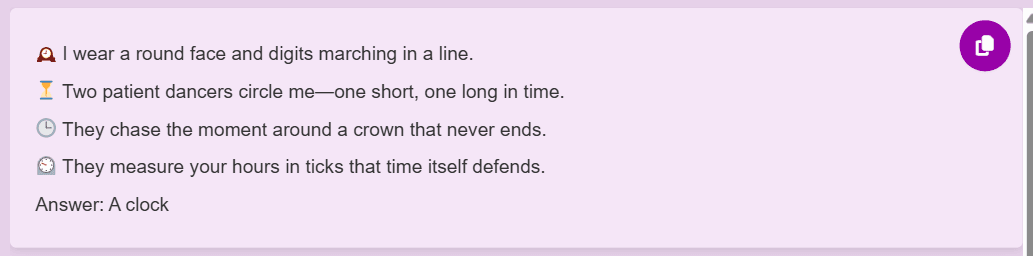
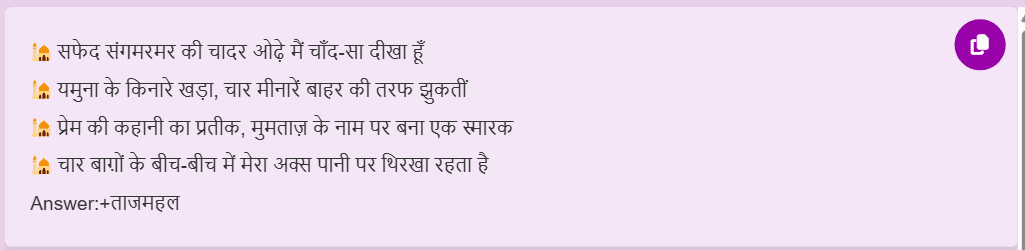
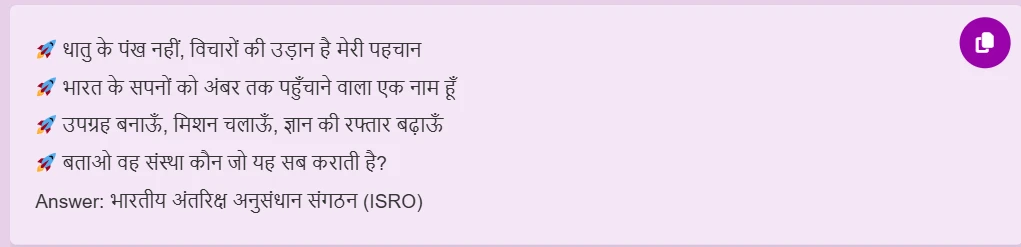
Here are some examples that were generated using the ToolifyPro riddle maker.
1. Tricky riddle on clock
2.Classic Riddle on Tajmahal in Hindi
3. Tricky riddle on ISRO in Hindi
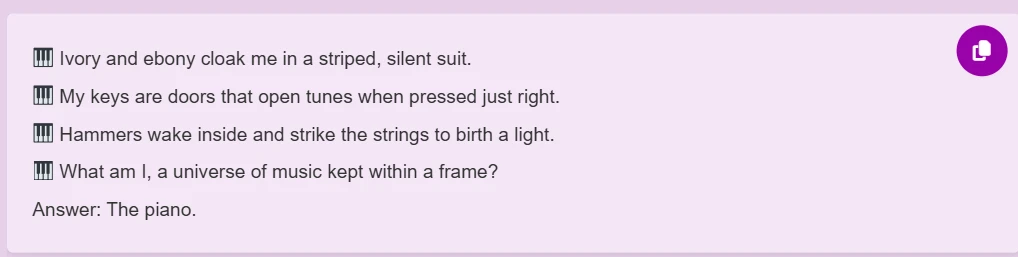
4. Tricky riddle on piano
Conclusion
A riddle is a small question statement that requires thinking to answer. It has been a fundamental part of the world’s play from the ancient age to the modern digital world. The word “riddle” was derived from the Old English word “rædels,” which meant “a thing that can be guessed.”
There are multiple definitions of the words “general,” “dictionary,” and “simple,” and each one follows a different pattern for the riddle. Humans enjoy riddles, which trigger curiosity and answers.
Questions are straightforward, while riddles follow a tricky pattern. Riddle is a great tool for learning for different age groups. The digital shift makes people more accessible to the online platforms like Riddle Creator instead of a book or hearing from someone else.