
YouTube is the world’s second-largest search engine after the Google search engine, processing billions of searches every month. Finding your video from billions of searches is not an easy task; creators often think of just uploading a video and hoping that the YouTube algorithm will do the rest of the work, but this is not completely true. Here YouTube SEO comes into the picture; it removes the guesswork and aligns the creator’s content on the right path to appear in the search results, feeds, and suggestions and to rank on top.
Table of Contents
What Is YouTube SEO?
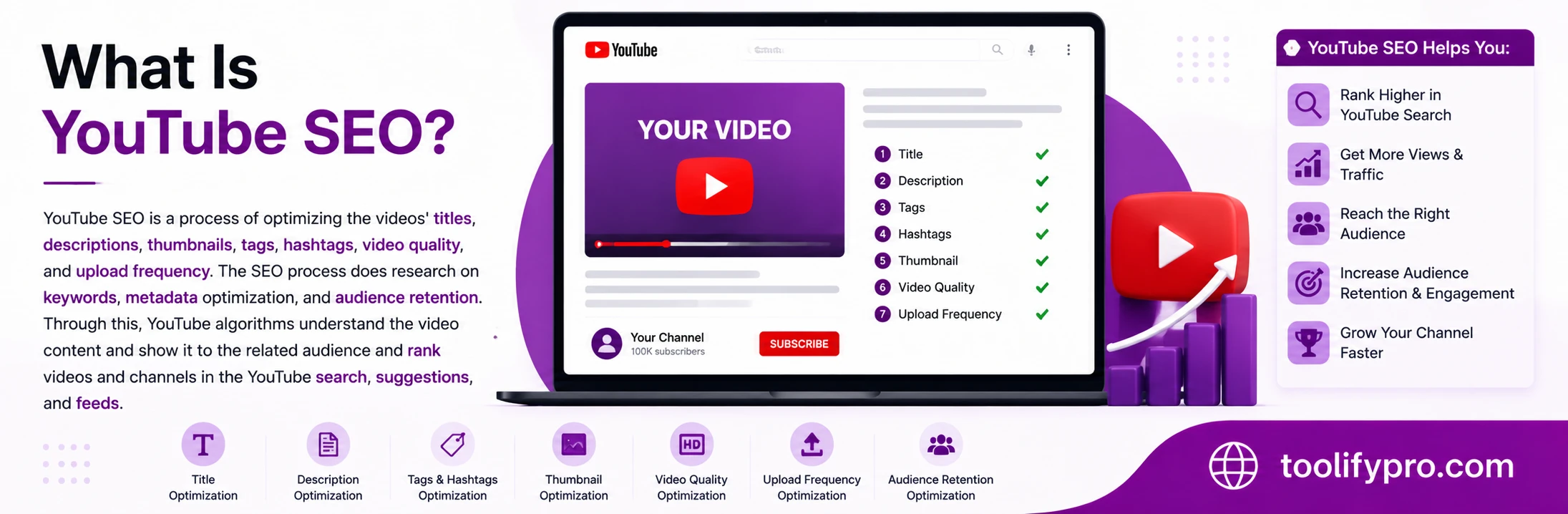
YouTube SEO is a process of optimizing the videos’ titles, descriptions, thumbnails, tags, hashtags, video quality, and upload frequency. The SEO process does research on keywords, metadata optimization, and audience retention. Through this, YouTube algorithms understand the video content and show it to the related audience and rank videos and channels in the YouTube search, suggestions, and feeds.
In simple terms, “YouTube SEO is a process that makes the creator’s content easy for both the algorithm and viewers.”
What Exactly Is SEO for YouTube?
Whereas previously SEO was considered to be web-only, where it heavily depended on backlinks and page authority, when talking about YouTube SEO, it depends on different factors.
- Relevance: The YouTube algorithm looks out for how well the video title, description, and tags match the search intent.
- Engagement: Click-through rate (CTR), watch time, likes, comments, and shares
- Session value: How long your videos stay with your viewers.
If the YouTube algorithm is satisfied with the above parameters, it starts rewarding and showing the user search intent.
Why Does YouTube SEO Matter?
YouTube crawls millions of videos every day, but only a few videos get ranked, because SEO directly affects the channel performance; without SEO, even the high-quality videos get outranked, especially the small channel videos. The YouTube algorithm needs the video’s relevance before ranking. Better SEO steps help rank the video.
Key reasons YouTube SEO is important:
- Increase the real organic traffic and views on videos.
- Improve video visibility in YouTube and Google search results
- Boost video ranking and suggest in the recommendations feeds.
- Build sustainable channels instead of relying on viral content only.
How Does YouTube SEO Actually Work?
There are multiple layers that YouTube analyzes and, based on that, ranks the videos.
- Crawling metadata—The algorithm reads the video title, description, captions, and tags and checks the relevance of the content.
- Matching search intent—In video descriptions, scan content and compare what the user is searching for.
- Testing with a small audience—YouTube starts displaying videos to a small audience and measures CTR and watch time.
- Scaling distribution—Based on the signals from the YouTube test, decide which videos rank; if a signal is found to be strong, then expand the video across the search, feed, and suggestions.
Two videos with the same topic can perform totally differently; one SEO-optimized gets a high viewership, and the other does nothing.
Why Do Some YouTube Videos Rank While Others Don’t?
YouTube video rankings depend on three main reasons.
- Search intent match: If the videos answer the user query, what they are searching for.
- Audience retention: How long viewers stay on videos gives a good signal of relevance.
- Metadata clarity: Search and compare queries in title, thumbnail, description, and tag that clearly communicate about videos.
Sometimes a video can lose the viewership even if it has perfect keywords if the viewer leaves the video in a few seconds; YouTube treats it as a low-quality signal.
What does YouTube consider for video ranking?
The YouTube algorithm considers the following factors that, mentioned below, influence the video ranking.
- Title that includes the relevant keywords
- Description that gives a brief overview of the video in the first 100 characters.
- Tags to match and categorize the relevant keywords.
- Measure the click-through rate (CTR) of videos.
- Average view duration and audience retention
- Video and channel engagement (likes, comments, shares, subscribes)
- Closed captions/transcript content
- Session watch time (how long viewers stay on YouTube after watching)
- Freshness and upload consistency
No single factor guarantees ranking—YouTube evaluates them together.
Does Watch Time Matter More Than Keywords?
Yes, good keywords help the YouTube algorithm discover and categorize the video, and hand-side watch time determines user retention and indicates that YouTube is promoting your videos. A well-optimized title can earn the initial click, but poor retention will stop the video from ranking further. Think of keywords as the door and watch time as proof the room is worth staying in.
Are YouTube Tags Still Important for SEO?
Yes, tags help in video discovery even if the user misspells while searching for videos, but the tags alone are not useful. Good titles, descriptions, thumbnails, and viewer engagement do actual work. Users can add 5-8 tags to their videos.
Does the YouTube Description Help SEO?
Yes, and it’s the most important part of videos; YouTube scans the first 100 characters from the video’s description and, based on that, decides ranking. But the description must be strong and include the following points.
- Include the primary keyword in the description naturally.
- Write a clear video context summary that describes the video.
- Include the video’s secondary keywords and timestamps, but avoid overstuffing.
Are Titles and Thumbnails More Important Than Tags?
Yes, titles and thumbnails are visible to the viewer directly, which influences the click-through rate and strong path of video ranking. But tags do their work in the backend; they give a signal to the YouTube algorithm and match video search keywords.
Can YouTube SEO Help a Small Channel Grow?
Yes, of course, small channels can grow if they target specific audiences and lower competition keywords instead of focusing on broader categories. The most important thing that matters for growth is consistency. Over time, YouTube started showing the small channel content to viewers.
Is YouTube SEO Different from Website SEO?
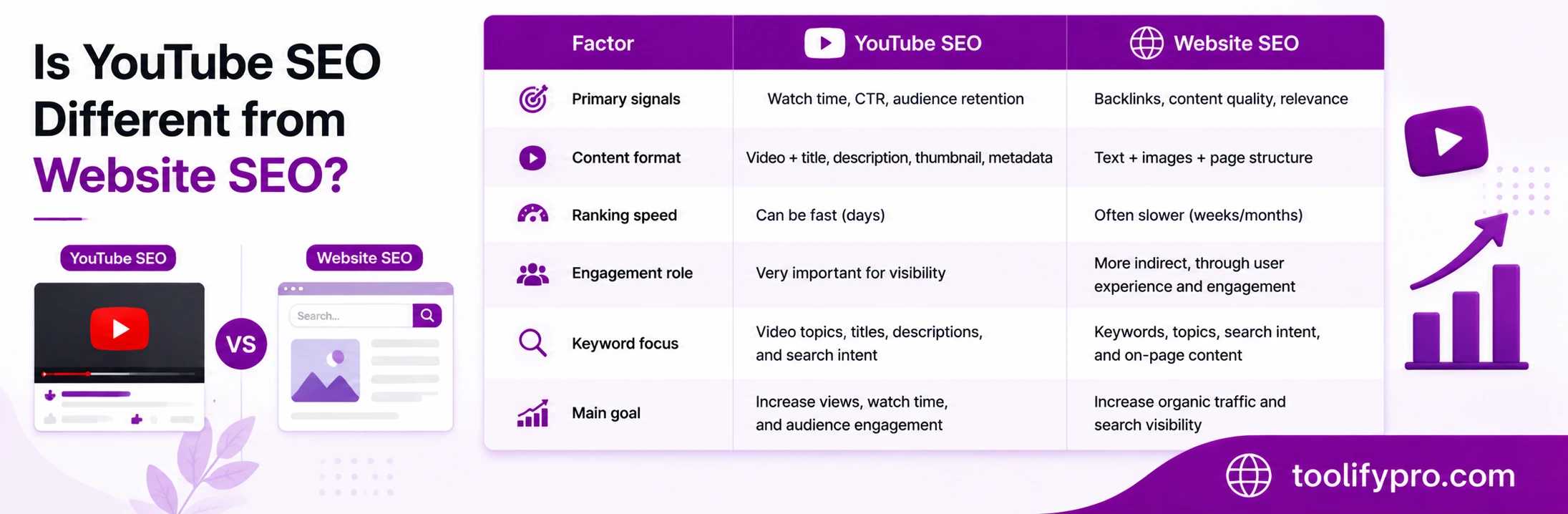
| Factor | YouTube SEO | Website SEO |
|---|---|---|
| Primary signals | Watch time, CTR, audience retention | Backlinks, content quality, relevance |
| Content format | Video + title, description, thumbnail, metadata | Text + images + page structure |
| Ranking speed | Can be fast (days) | Often slower (weeks/months) |
| Engagement role | Very important for visibility | More indirect, through user experience and engagement |
| Keyword focus | Video topics, titles, descriptions, and search intent | Keywords, topics, search intent, and on-page content |
| Main goal | Increase views, watch time, and audience engagement | Increase organic traffic and search visibility |
Frequently Asked Questions (FAQ)
What is YouTube SEO?
YouTube SEO is a process of optimizing the metadata to rank videos in YouTube search, feeds, and suggestions.
How does YouTube SEO actually work?
YouTube matches your metadata to search queries, tests your video with a small audience, then scales distribution based on engagement performance.
Why do some YouTube videos rank while others don’t?
Videos that rank on YouTube have clear metadata matches with users’ search intent, but non-ranking videos might not have clear metadata and have lower retention.
What factors does YouTube use to rank videos?
Keyword relevance, CTR, watch time, engagement, captions, and session duration are the main factors.
Does watch time matter more than keywords?
Both have their own tasks, whereas keyword help for video discovery and watch continues promotion.
Are YouTube tags still important for SEO?
Tags build a base to match the video keyword in the search results even if the user mistypes, but the title, description, thumbnail, and engagement are more important.
Can I improve YouTube SEO without paying for tools?
Yes, the YouTube autocomplete feature helps you to find keywords, and the Toolify Pro YouTube SEO tools analyze and improve the metadata optimization.
What are the best free resources to learn YouTube SEO?
YouTube Creator Academy, YouTube Analytics, and Google Search Central are strong starting points.